 ultimate-guide
Residential Meaning: A Complete Guide to Property Types
Table of Contents
- What Residential Meaning Covers in Everyday and Legal Use
- What Counts as a Residential Address
- Types of Residential Property: Houses, Townhouses, Units and Flats
- Residential vs Commercial Property: Where the Line Falls
- Residential Property Costs and Ongoing Ownership Expenses
- Planning, Zoning and Building Rules for Residential Land
- Residential Property Investment and Market Indicators to Watch
- Conclusion
- Frequently Asked Questions
Last Updated: October 5, 2026
What Residential Meaning Covers in Everyday and Legal Use
Residential describes land and buildings used as places for people to live, rather than for business, industry or retail. In everyday speech it means housing; in planning law it means land zoned and lawfully occupied for dwelling purposes.
That gap between the everyday and the legal definition is where most confusion starts. At YardBirds Sydney, we work across residential, strata and commercial gardens, and the distinction matters long before anyone mows a lawn: it determines what can be built, how the site is serviced, and who is responsible for upkeep.
The term also carries a second, narrower sense. As a residential address, it refers to the place where a person actually lives, which is why banks, electoral offices and government agencies ask for it separately from a postal address.
What Counts as a Residential Address
A residential address is the physical location where a person lives, such as a house, unit or flat, and it is distinct from a postal or business address. It is the address you would give a utility provider, a school or a lender.
Not every dwelling qualifies in every context. Caravans, houseboats and short-stay accommodation can be someone's home without being treated as a standard residential address for rates, mail or lending purposes.
For owners, the address on record affects rates notices, insurance and strata correspondence. For renters, it affects bond lodgement and utility connections. Getting it right at the start avoids disputes later.
Types of Residential Property: Houses, Townhouses, Units and Flats
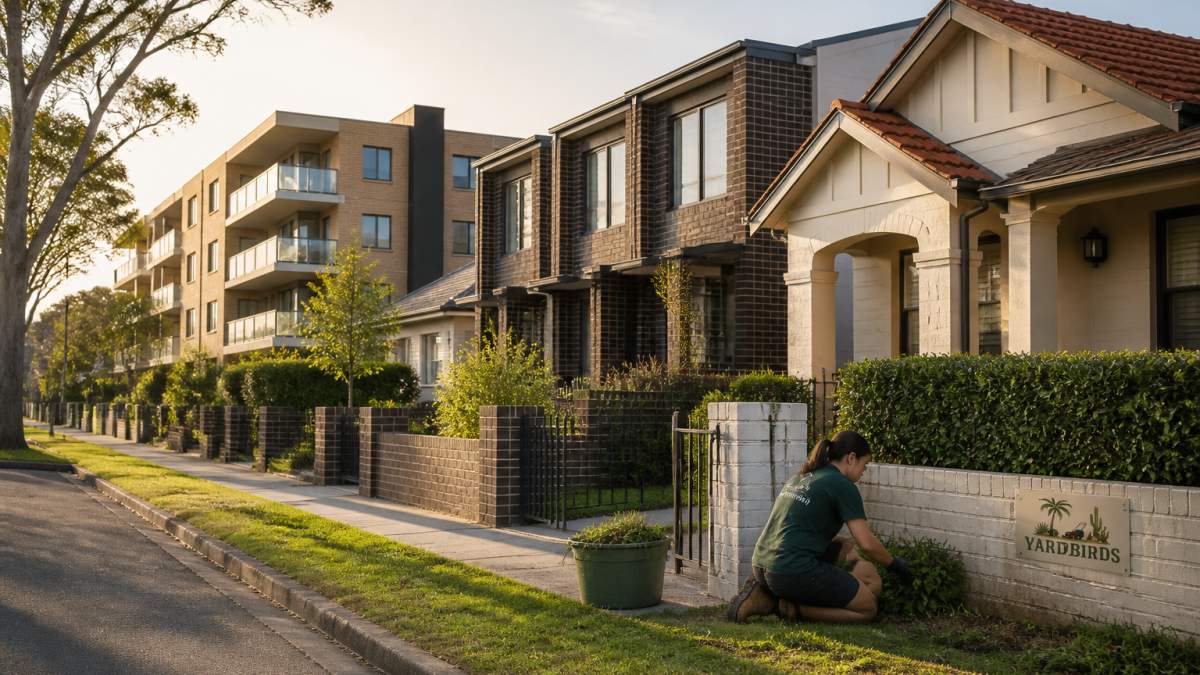
Australian housing stock falls into a handful of recognisable categories, and each one shapes how a home is lived in, maintained and valued. The main split is between standalone dwellings and attached dwellings.
Standalone Houses and Duplexes
A standalone house sits on its own title with its own land, which typically means more floor area, a private yard and greater freedom to renovate. A duplex splits one building into two dwellings, either side by side or one above the other, and can be held under separate titles or as a single lot.
The trade-off is maintenance. More land means more garden, more fencing and more outdoor upkeep, which is where a regular residential garden service earns its keep.
Townhouses, Units and Flats
Townhouses share walls but usually keep a small private courtyard. Units and flats are dwellings within a larger building, often with shared entryways, lifts and common gardens.
Shared property means shared responsibility. Strata or body corporate arrangements govern common areas, and garden maintenance for those areas is typically arranged collectively rather than by individual owners.
| Dwelling type | Land | Common property | Typical upkeep |
|---|---|---|---|
| Standalone house | Own title | None | Full private garden |
| Duplex | Own or shared title | Sometimes | Shared boundary areas |
| Townhouse | Small private yard | Often | Courtyard plus common areas |
| Unit or flat | None | Yes | Common areas only |
Residential vs Commercial Property: Where the Line Falls
The dividing line between residential and commercial comes down to use, not appearance. A dwelling used as a home is residential; the same building used as an office, shop or short-stay business may be classified as commercial for planning, rating and insurance purposes.
This matters because obligations change with the classification. Insurance cover, rates, tax treatment and building requirements all follow the use, not the walls. A home office in a spare room usually stays residential. A converted shopfront with a steady stream of clients often does not.
For anyone running a business from home, the sensible step is to confirm the current use with the local council before making changes. Rules vary between councils, and a use that is accepted in one area may need approval in another.
Mixed-Use and Industrial Property
Mixed-use buildings combine residential dwellings with ground-floor shops or offices, common in inner-city areas. Industrial land is set aside for manufacturing, warehousing and similar activities, and is generally not suitable for occupation as a home.
The practical takeaway: never assume a property's classification from its street. Check the zoning and the approved use.
Residential Property Costs and Ongoing Ownership Expenses
Buying a home is the headline cost, but ownership carries recurring expenses that many first home buyers underestimate. Budgeting for these early prevents surprises in the first year. Below is a practical breakdown of the main costs, with typical ranges and the mechanisms behind them.
- Council rates: Levied annually by local councils based on property value. Rates fund local services such as roads, parks and waste collection. The amount varies by council and property valuation; a common pattern is that rates rise with land value.
- Water and sewerage charges: Usually billed quarterly by the local water authority. Charges include a fixed supply component and a usage component. Some councils include water in rates; others bill separately.
- Insurance: Building insurance covers the structure; contents insurance covers belongings. For strata properties, building insurance is typically arranged by the body corporate and included in levies, so owners only need contents cover. Premiums depend on location, building age and sum insured.
- Strata levies: For units, townhouses and other strata schemes, levies cover common property maintenance, insurance and administrative costs. Levies are set annually by the owners corporation and can be special levies for major works. A common pattern is that older buildings have higher levies due to deferred maintenance.
- Maintenance: Ongoing repairs and upkeep. For standalone houses, this includes gutters, roofing, fencing and garden care. A useful rule of thumb is to budget around 1% of the property's value annually for maintenance, though this varies with age and condition.
- Utilities: Power, gas and internet connections. These are usage-based and vary by household size and efficiency. Energy-efficient homes can significantly reduce these costs.
- Garden and grounds costs: Easy to overlook, these add up across a year. For strata schemes, common-area upkeep is shared through levies, which is why many bodies corporate engage a regular contractor rather than arranging one-off visits. For private gardens, costs depend on size, plant selection and frequency of service.
Pricing for any of these services depends on the size of the property, the condition of the garden and how often you need it attended to. It is worth requesting a quote rather than working from a rough guess. As a limited-time offer, we are currently providing 10% off our Spring Special Weed and Feed service.
Planning, Zoning and Building Rules for Residential Land
Planning controls decide what can be built where, and they are set through state planning legislation and administered by local councils. Zoning maps show which land is set aside for residential use, and development applications handle proposals that go beyond what is permitted without consent.
Rules differ between states and between councils, so the only reliable source is the planning scheme that applies to the specific block. Key considerations usually include:
- Minimum lot sizes and subdivision rules
- Setbacks, height limits and site coverage
- Heritage and environmental overlays
- Bushfire, flood and other hazard requirements
Building work also needs to meet the relevant construction standards, and certain work requires a licensed tradesperson or certifier. If you are planning an extension, a new dwelling or a granny flat, check with your local council early. Approvals take time, and discovering a constraint after you have engaged a builder is an expensive way to learn the rules.
Residential Property Investment and Market Indicators to Watch
Investors track a handful of signals to judge whether a residential market is running hot, cooling or holding steady. No single indicator tells the whole story, but together they sketch the picture. Here is how to read them and what they mean for your investment strategy.
- Median prices and median weekly rents: The baseline for comparing suburbs. Median price is the midpoint of all sales; median rent is the midpoint of all rental listings. A rising median price with stagnant rents can signal an overvalued market, while rising rents with stable prices may indicate a tightening rental market.
- Vacancy rates: The percentage of rental properties that are vacant. A low vacancy rate (typically under 2%) favours landlords because demand outstrips supply, pushing rents up. A higher vacancy rate (above 3%) favours renters and can lead to rent reductions. Vacancy rates are published by state housing authorities and private data providers.
- Days on market: The average number of days a property takes to sell. Shorter periods suggest stronger demand and can indicate a seller's market. Longer periods suggest a buyer's market, giving buyers more negotiating power.
- Auction clearance rates: The percentage of properties sold at auction. A clearance rate above 70% generally indicates a strong market; below 60% suggests a weaker market. These rates are reported weekly by real estate institutes in each state.
- Rental yields: Gross rent against purchase price, expressed as a percentage. Gross yield = (annual rent / purchase price) × 100. Net yield subtracts ongoing costs such as rates, insurance, maintenance and management fees. Yields vary by location and property type; units often have higher gross yields but higher strata levies, while houses may have lower yields but greater capital growth potential.
For owners rather than investors, the same figures are useful context when refinancing or planning a renovation. A well-kept garden and tidy street frontage do not change the median, but presentation affects how a property is received at inspection, whether it is a sale or a new lease. In a competitive market, a maintained garden can be a differentiator that attracts tenants or buyers.
As a limited-time offer, we are currently providing 10% off our Spring Special Weed and Feed service, a practical way to enhance your property's street appeal before inspections or to keep your investment looking its best.
Conclusion
Residential covers more ground than most people expect: a legal land use, a dwelling type, an address and an ongoing set of costs and obligations. Getting the classification right protects you at purchase, at tax time and when you deal with council.
YardBirds Sydney keeps residential grounds in order with all-electric equipment, reliable scheduling and careful lawn shaping suited to local conditions. We are fully insured, have served more than 500 customers across Sydney's Inner West with a 97% satisfaction rate, and bring over 12 years of experience to every property. Get a Free Quote and enjoy a garden that stays presentable all year.
Frequently Asked Questions
What does residential mean in simple terms?
Residential describes a place used for people to live in, rather than for business, industry or retail. A house, townhouse, unit or flat is residential property when it is lawfully occupied as a home. The term also covers the zoning that permits housing, and the address attached to where someone lives. So a residential area is one set aside mainly for homes, schools and local services rather than factories or warehouses.
What is the difference between residential and commercial property?
Residential property is built and approved for people to live in. Commercial property is used for business: offices, shops, warehouses and similar. The distinction matters because zoning, insurance, lending and tax treatment differ between the two. A building used as a home is residential even if the occupant runs a small business from it, though local planning rules may limit how much of the property can be used that way.
Is an apartment considered residential property?
Yes. Apartments, units and flats are residential property when people live in them. They sit under the same broad definition as houses and townhouses, even though ownership often involves strata or owners corporation arrangements for shared areas such as gardens, driveways and lobbies. Those shared areas still form part of the residential building and are managed collectively by the owners.
What is a residential address used for?
A residential address is the place where a person lives, and it is used for things like electoral enrolment, licence records, banking, insurance and deliveries. It differs from a postal address or a business address, which may be a PO box or an office. Government agencies and lenders usually want the address where you actually reside, not a mailing address you use for convenience.