 comparison
Why Electric Lawn Mowers Are Better: A 2026 Guide
Table of Contents
- Why Electric Lawn Mowers Are Better: The Core Advantages
- Battery Lawn Mower Run Time: What to Expect
- Electric vs Petrol Lawn Mower Maintenance: A Clear Winner
- Top Models: A Comparison of Electric Mowers
- The Best Electric Garden Tools for Weeds
- Performance on Slopes, Thick Grass, and Terrain
- Long-Term Costs: Battery Degradation and Repairability
- Conclusion: Making the Switch to Electric
- Frequently Asked Questions
Last Updated: September 16, 2026
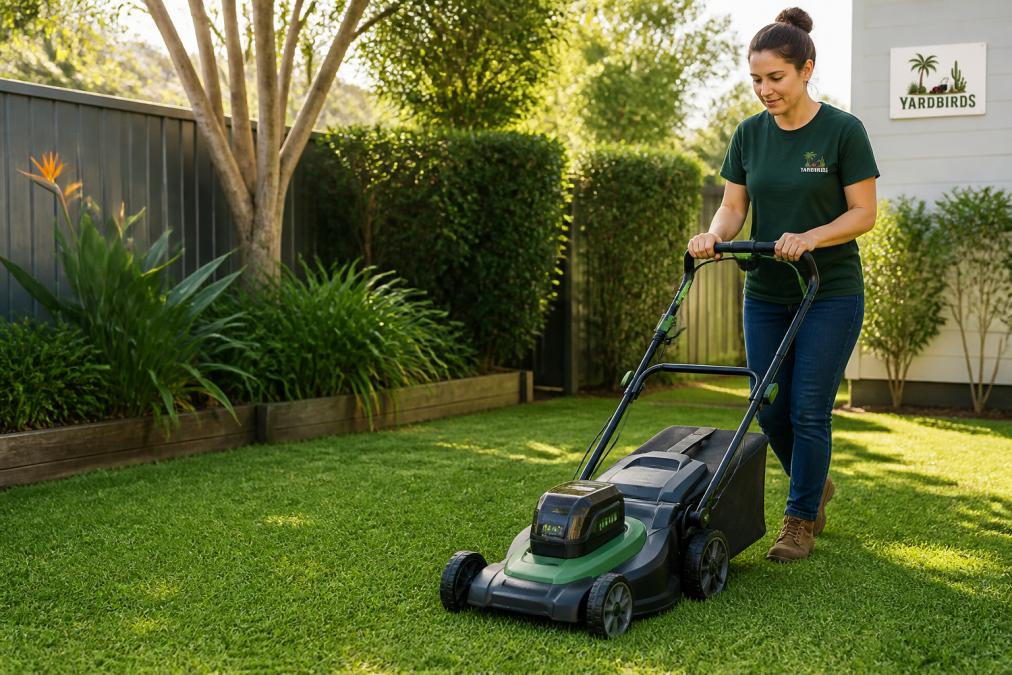
Why Electric Lawn Mowers Are Better: The Core Advantages
Electric lawn mowers are better for most suburban blocks because they start instantly, run without petrol or oil, and significantly reduce noise and air quality emissions compared with petrol engines. For anyone considering a switch, this combination of lower running costs and less maintenance is compelling.
YardBirds Sydney has used all-electric equipment across the Inner West for years, so we understand where battery mowers excel and where they require operator adjustment.

Petrol mowers require fuel, oil changes, spark plugs, air filters, and a pull-cord that eventually fails. A battery mower needs a charged power pack and a sharp blade – that's the extent of the maintenance.
The other significant advantage is noise. Petrol mowers often exceed acceptable noise levels for residential areas early on a Sunday. A cordless mower allows you to mow at 7am without disturbing neighbours.
- Zero exhaust emissions at the point of use, which is beneficial in densely populated streets
- Push-button start instead of repeated pulling
- No fuel storage required in the garage or shed
- Lighter decks reduce fatigue on sloped blocks
Battery Lawn Mower Run Time: What to Expect
Battery lawn mower run time is the primary factor determining if electric suits your block. Most 56V and 60V mowers provide approximately 30 to 60 minutes of cutting per charge, depending on deck size, grass thickness, and whether the self-propel feature is engaged.
Understanding Voltage and Amp-Hours
Voltage determines the power output; amp-hours (Ah) indicate the capacity. A 5.0Ah battery at 56V holds more usable energy than a 2.5Ah pack at the same voltage. This is why two smaller packs can often outperform one large one on a substantial lawn.
Tips for Maximising Runtime
- Cut when the grass is dry, not immediately after rain.
- Raise the deck in summer and make two passes if necessary.
- Use eco-mode if your mower offers it.
- Keep blades sharp; dull blades increase motor strain.
- Store batteries indoors, away from excessive heat.
Electric vs Petrol Lawn Mower Maintenance: A Clear Winner
Electric mowers win the maintenance comparison decisively. There's no oil to change, no spark plug to replace, no air filter to clean, and no fuel to drain at the end of the season.
A petrol mower typically requires an annual service, fresh fuel, and a carburettor that functions correctly. Neglecting these can lead to extended starting times.
Battery mowers demand very little: wipe down the deck, inspect the blade, and charge the battery appropriately. Over a season, this translates to significant time savings.
The main consideration is the battery itself.
Top Models: A Comparison of Electric Mowers
The ideal mower depends on your block size, terrain, and whether you already own batteries from a specific tool brand. Below is a comparison of leading cordless models based on key specifications and performance notes.
| Model | Deck Size | Starting Price | Best For |
|---|---|---|---|
| EGO Power+ 56V Select Cut | 52cm | $899 AUD | Large lawns, petrol-like power |
| Ryobi 40V HP Brushless | 51cm | $649 AUD | Value seekers, medium blocks |
| Greenworks 60V Cordless Mower | 43cm | $449 AUD | Small, tight gardens |
| Stihl RMA 460 V | 46cm | $799 AUD | Build quality, frequent use |
| DeWalt 54V XR FlexVolt | 53cm | $999 AUD | Existing DeWalt battery owners |
EGO Power+ 56V Select Cut Mower
The EGO Power+ 56V Select Cut offers performance comparable to petrol mowers. Its Select Cut multi-blade system allows for easy switching between mulching and bagging configurations, and the 56V ARC Lithium platform enables battery sharing across the EGO range.

Ryobi 40V HP Brushless 51cm Self-Propelled Mower
Ryobi's 40V HP Brushless model is a strong value proposition. Dual battery ports extend run time, the brushless motor provides ample torque, and the seven-position single-point height adjustment is user-friendly.
Greenworks 60V Cordless Mower
Greenworks designed this mower for compact areas. The 43cm deck easily navigates narrow paths and around garden beds, and the unit is lightweight enough for carrying up steps.
Stihl RMA 460 V Cordless Lawn Mower
Stihl's RMA 460 V is built for durability. It features variable speed self-propulsion, an eco-mode that adjusts motor speed to conserve battery, and a flow-optimised blade for extended run time. (Source: understanding voltage and amp-hours)

DeWalt 54V XR FlexVolt Self-Propelled Mower
DeWalt's FlexVolt mower is suited for demanding tasks. The steel deck is strong for rougher ground, and the 54V FlexVolt batteries are compatible with DeWalt's high-power cordless tools.
Matching the Mower to Your Block
A 400-square-metre flat block with dense grass like kikuyu or buffalo can be effectively managed by any 40V or 56V push mower with a 46cm deck. For a 700-square-metre block with a slight incline, a self-propelled model offers added convenience for an additional cost of $150 to $250. For blocks exceeding 1000 square metres, or those with steep inclines, a 56V or 60V self-propelled model with a 50cm-plus deck and a spare battery is recommended.
The Best Electric Garden Tools for Weeds
The most effective electric garden tools for weed management include a line trimmer for edges and fence lines, a brush cutter for dense vegetation, and a battery sprayer for targeted application. In most systems, these tools utilise the same power packs as your mower.
Performance on Slopes, Thick Grass, and Terrain
Electric mowers perform well on slopes and in thick grass, provided the machine is appropriately matched to the task. Self-propelled models with higher voltage are suitable for inclines, while lighter push models are better suited for flat, open areas.
- Flat blocks: Any voltage works; push models are adequate.
- Gentle slopes: Self-propel functionality is worth the additional investment.
- Steep banks: Higher voltage and a larger deck are recommended, or consider professional services.
- Thick, overgrown patches: Mow at a higher setting first, then lower the deck for a second pass.
Long-Term Costs: Battery Degradation and Repairability
The overall cost of ownership for an electric mower is typically lower than petrol models over several years, but battery lifespan is a factor buyers often underestimate. Lithium-ion packs gradually lose capacity, and replacing a pack represents a tangible cost when it eventually fails.
What Battery Degradation Actually Looks Like
A lithium-ion pack in a mower generally retains about 80% of its original capacity after 300 to 500 full charge cycles. For a household mowing once a week during an eight-month growing season, this equates to approximately four to six years before a noticeable reduction in run time occurs. Capacity loss is not linear; the initial 10% often occurs within the first year, followed by a slower decline before a more significant drop after the 300-cycle mark.
Repairability and Parts Availability
Repairability presents another challenge. While battery mowers have fewer moving parts, sourcing replacement motors and control boards can be difficult for some brands. Verifying parts availability before purchase can prevent future complications.
The Storage Advantage
Storage is a quiet benefit. Folding handles and vertical storage allow a cordless mower to occupy significantly less shed space than a petrol unit, eliminating the need for a separate fuel can. A typical cordless mower requires approximately 60cm by 50cm of floor space when folded, compared to a petrol mower which needs its full footprint plus space for a fuel can and oil bottle.
Conclusion: Making the Switch to Electric
Transitioning to an electric mower is straightforward for most properties, but it requires careful consideration of run time, terrain, and battery compatibility before purchase. Getting these aspects right ensures you won't miss petrol-powered alternatives.
Frequently Asked Questions
What are the main disadvantages of electric lawn mowers?
The primary drawbacks include a higher initial purchase price for premium models and limited run time compared to petrol mowers. Battery lawn mower run time typically ranges from 30 to 60 minutes, influenced by battery capacity and grass conditions. You might need spare batteries for larger yards. Furthermore, battery degradation over several years can incur replacement costs. However, these are often balanced by reduced maintenance needs and zero fuel expenses.
Are electric lawn mowers as powerful as petrol models?
Modern high-voltage electric mowers, such as 56V or 60V models, deliver comparable torque and blade speed to many petrol mowers. They effectively handle thick grass and tough summer weeds, particularly brushless motor variants. The key distinction is that electric mowers maintain consistent power without the associated noise and emissions. For very overgrown or steep terrain, a self-propelled electric model is advisable.
How long do batteries typically last in electric lawn mowers?
Lithium-ion batteries generally provide between 500 and 1,000 charge cycles, translating to approximately 3 to 5 years of regular use. Factors such as storage temperature, charging practices, and depth of discharge influence their lifespan. To maximise battery life, avoid leaving batteries fully discharged for extended periods and store them in a cool, dry environment. Replacement batteries are available for most major brands.
Is it okay to cut wet grass with an electric lawn mower?
It is not recommended to cut wet grass with any lawn mower, electric or petrol. Wet grass tends to clump, clog the mower deck, and can strain the motor. For electric mowers, moisture increases the risk of electrical issues and corrosion. It is best to wait for dry conditions. If mowing is unavoidable, use a higher cutting height and clean the deck thoroughly afterwards to prevent rust and maintain performance.