 comparison
Electric Lawn Mower Power vs Petrol: 2026 Comparison
Table of Contents
- Electric Mower Power vs Petrol: The Complete Comparison
- Power and Performance: Torque, Horsepower and Cutting Through Thick Grass
- Battery Lawn Mower Runtime: What to Expect in Real Conditions
- Electric Lawn Mower Maintenance Tips That Save You Time and Money
- Best Electric Garden Tools for Weeds and Edge Maintenance
- Cost of Ownership: Purchase Price, Running Costs and Repairability
- Safety, Storage and Noise: What Australian Standards Require
- Conclusion: Which Mower Suits Your Lawn and Lifestyle?
- Frequently Asked Questions
Last Updated: September 11, 2026
Electric Mower Power vs Petrol: The Complete Comparison
The electric lawn mower power vs petrol debate has shifted dramatically, and the gap is narrower than most people assume. At YardBirds Sydney, we run all-electric equipment across hundreds of properties every month. This comparison breaks down torque, runtime, maintenance, running costs and safety so you can choose with facts rather than folklore.
The short answer: for most suburban lawns, a modern brushless electric mower delivers comparable cutting power to a small petrol engine, with far less noise and no exhaust emissions. Where petrol still leads is sustained heavy-duty work on very large or severely overgrown blocks.
Power and Performance: Torque, Horsepower and Cutting Through Thick Grass
Torque, not horsepower, is what actually cuts grass. Electric motors produce maximum torque from zero RPM, so a battery mower powers through dense growth without bogging down the way a petrol unit does under load (energy.gov).

How Brushless Motors Deliver Torque Without Horsepower Ratings
Brushless motors convert battery energy to blade torque more efficiently than brushed motors, with fewer moving parts. Petrol engines peak at specific RPM; electric motors deliver consistent torque across their range, which matters most when the blade hits a thick patch and must hold its speed.
Performance on Kikuyu, Buffalo and Couch Grass
Grass type changes everything. Kikuyu forms a dense mat that resists a dull blade; Buffalo's broad, soft leaves suit a sharp electric mower; Couch is fine and tough, and rewards a higher cutting height in summer. The rule: keep the blade sharp, mow often in peak growth, and never let grass get so long that any mower works at its limit.
Battery Lawn Mower Runtime: What to Expect in Real Conditions
Battery lawn mower runtime depends on voltage, amp-hour capacity and workload. A higher-voltage, larger-Ah battery runs longer, but thick, damp grass drains it faster than a light trim on dry turf.
Voltage, Amp-Hour Ratings and Recharge Time Explained
Voltage determines the power available to the motor; amp-hours (Ah) determine how long it lasts. A 56V or 80V system with a high-Ah battery outlasts a smaller pack. Recharge time varies by charger and pack size, so many owners buy a second battery and keep one charging while the other works.
| Factor | What It Affects | Practical Tip |
|---|---|---|
| Voltage | Motor power and torque | Higher volts suit thicker grass |
| Amp-hours (Ah) | Runtime per charge | Buy a second pack for large blocks |
| Deck size | Coverage per pass | Bigger deck, faster finish |
| Grass condition | Battery drain rate | Mow dry, mow often |
Electric Lawn Mower Maintenance Tips That Save You Time and Money
Electric mower maintenance is genuinely lighter than petrol: no oil changes, spark plugs, air filters, carburettor cleaning, fuel stabiliser or annual tune-up. What remains is a short, high-leverage list, and one long-term cost most guides skip.
The Routine That Actually Matters
- Blade sharpening: every 20-25 hours, or sooner if the cut looks ragged. A dull blade is the biggest cause of "my electric mower feels weak" complaints, the blade is tearing, not slicing.
- Deck clearing: after every few mows, especially in damp conditions. Caked clippings reduce airflow and force the motor to work harder.
- Battery terminal check: wipe terminals dry and free of grass dust. Moisture and debris cause intermittent cut-outs.
- Airflow check: keep the rear discharge chute and catcher vents clear. Restricted airflow is the second-most-common cause of premature thermal shutdown.
- Storage charge: store lithium-ion packs at roughly 40-60% charge if unused for more than a month. Full-charge storage accelerates capacity loss.
With no oil change equivalent, annual maintenance time is a fraction of a petrol mower's, but only if you actually do the blade and deck work.
Long-Term Battery Degradation: The Cost Most Guides Ignore
Lithium-ion packs are consumable. They do not fail suddenly; they lose capacity gradually. A pack that ran 45 minutes when new may run 30 minutes after several seasons, and that degradation changes the "cheaper to run" narrative (peer-reviewed research).
What drives degradation:
- Heat: storing a pack in a hot shed or direct sun is the fastest way to shorten its life. Cool, dry storage is the main lever you control.
- Deep discharge: repeatedly running a pack flat to shutdown stresses the cells. Recharging at around 20% remaining is gentler than running to zero.
- Full-charge storage: leaving a pack at 100% for weeks accelerates capacity fade.
- Cycle count: every full charge/discharge cycle consumes part of the pack's life. One deep discharge per session is harder on the pack than splitting the job across two shorter sessions with a mid-charge.
The budget implication: factor at least one replacement pack into a five-to-seven-year ownership window. Many owners of larger blocks buy a second pack early as a rotation strategy that halves the depth of discharge on each pack and extends the life of both. That cost belongs in your total-cost-of-ownership maths before you buy.
Repairability: Where Petrol Still Has an Edge
Petrol engines are broadly owner-serviceable. A mechanically minded owner can replace a spark plug, clean a carburettor, change a fuel line or rebuild a pull-start with basic tools and a manual. Parts are widely available and independent small-engine repairers are common.
Battery mowers are different. Failure points are fewer, no fuel, ignition or exhaust system, but when something fails it is often the battery, controller or motor, frequently proprietary and sealed. A controller fault is not a DIY repair; it is a parts swap or a write-off. The practical consequence:
- Fewer things go wrong, but failures tend to be more expensive and less repairable at home.
- Warranty terms matter more on a battery mower. Check what the battery warranty covers and for how long, separately from the mower warranty.
- Parts availability for older battery models can be thinner than for petrol, because battery platforms change more frequently than engine designs.
For a household lawn, the trade-off usually favours electric: less routine maintenance, no fuel handling, no annual service. For someone who wants a machine running 15 years and is comfortable with a spanner, petrol remains more repairable long-term.
Best Electric Garden Tools for Weeds and Edge Maintenance
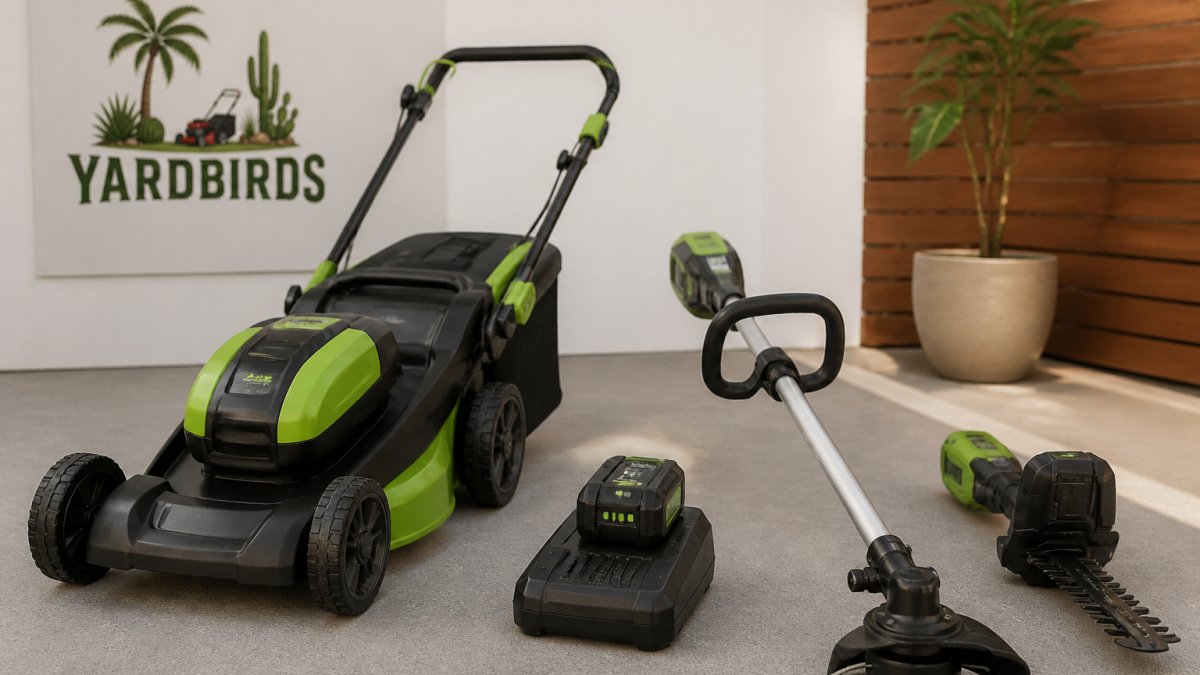
The best electric garden tools for weeds and edge maintenance are a line trimmer, an edger and a small brushcutter, all running on the same battery platform as your mower. Matching platforms means one charger and interchangeable packs across your whole shed.
- Line trimmer: edges paths, fences and garden beds
- Edger: cuts a clean line along driveways and paving
- Brushcutter: clears tough weeds and overgrown corners
- Blower: clears clippings from paths and decks
Cost of Ownership: Purchase Price, Running Costs and Repairability
Electric mowers usually cost more upfront but less to run and service: no fuel, oil, spark plug or annual tune-up, so running costs are largely electricity and the occasional blade sharpening.
Petrol mowers cost less to buy but carry ongoing fuel, oil, filter and service costs, plus more downtime. Petrol has more serviceable parts and a longer established repair network; electric has fewer failure points but battery and electronics replacement can be costly. For most household lawns, electric total cost of ownership wins over several years; for large acreage worked hard, petrol can still compete.
Safety, Storage and Noise: What Australian Standards Require
Safety is where the two power sources diverge most sharply, and where most comparison articles say almost nothing useful. The risks are not equivalent, and neither are the storage rules.
Noise: The Practical Difference
Petrol mowers are loud enough that prolonged exposure without hearing protection is a genuine concern, and many councils enforce time-of-day restrictions on powered garden equipment. Battery mowers are dramatically quieter, closer to a household appliance than a small engine, which means:
- You can mow earlier or later without disturbing neighbours.
- Hearing protection is usually unnecessary (though check your manual).
- You are far less likely to trip a council noise complaint, which in some areas carries penalties.
Noise rules vary by council and state. Check your local council's website for permitted hours, the rules are not uniform across the country.
Petrol Safety: Fuel and Carbon Monoxide
The petrol risks are well understood but frequently under-respected:
- Carbon monoxide: petrol engines produce it continuously. Never run a petrol mower in a garage, shed or any enclosed space, even with the door open. CO is odourless and accumulates to dangerous levels quickly.
- Fuel handling: store petrol only in approved containers, away from ignition sources, and never refuel a hot engine. Spilled fuel on a hot exhaust is a common cause of mower fires.
- Fuel storage limits: legal limits apply to how much petrol you can store at a residential property without a licence or specific storage arrangements. Check with your state's work health and safety regulator or fire authority.
Battery Safety: Thermal Runaway and Storage
Lithium-ion batteries carry a different risk profile. The headline risk is thermal runaway, a chain reaction inside the cell producing heat, gas and, in serious cases, fire that is hard to extinguish with water alone. It is rare but real, and it is why storage rules matter.
Practical storage rules for lithium-ion packs:
- Store cool and dry, out of direct sun and away from heat sources. A hot shed in summer is a poor location.
- Do not store on charge indefinitely. Once charged, remove the pack from the charger.
- Store away from flammable materials, not above paint thinners, petrol cans or cardboard.
- Do not store damaged packs indoors. A swollen, punctured or dropped pack should be isolated and disposed of through a proper battery recycling channel.
- Charge on a non-combustible surface where practical, and never charge unattended overnight where a fire would block your exit.
- Follow the manufacturer's charger. Mixing chargers across brands or voltages commonly causes pack damage and, rarely, failure.
Disposal and Recycling
Neither fuel nor batteries belong in general waste. Petrol must go to a licensed hazardous waste facility. Lithium-ion packs should go to a dedicated battery recycling drop-off, most councils and many hardware retailers provide these. Never put a lithium-ion pack in kerbside recycling; it is a known cause of fires in waste trucks and facilities (the EPA).
What to Check Locally
Regulations on noise hours, fuel storage limits and battery disposal are set at state and council level and change periodically. Before you buy, check:
- Your local council's permitted hours for powered garden equipment.
- Your state work health and safety regulator or fire authority for residential fuel storage limits.
- Your council's battery and hazardous waste drop-off arrangements.
Always follow the manufacturer's instructions for your specific mower and battery.
Conclusion: Which Mower Suits Your Lawn and Lifestyle?
Choosing between electric and petrol comes down to your block, your grass and how much maintenance you want to do. For most suburban homes, a brushless electric mower with a spare battery handles the job with less noise, no fumes and lower running costs.
If you would rather skip the equipment entirely, YardBirds Sydney brings all-electric mowing and garden maintenance to homes, strata and commercial properties across the Inner West. Our fully insured team has looked after 500+ customers with a 97% satisfaction rate over 12+ years, and we shape each visit around your schedule and your garden's needs. Get a Free Quote and let us keep your lawn thriving without the fumes or the fuss.
Frequently Asked Questions
Do electric lawn mowers have as much power as petrol mowers?
Modern brushless electric mowers deliver comparable torque to petrol models for typical suburban lawns. However, high-displacement petrol mowers still hold an advantage in extremely long or damp grass. For most residential blocks, electric mower power is sufficient, especially with sharp blades and a slower pass speed.
Are electric lawn mowers suitable for large, thick grass?
Electric mowers handle medium to large residential lawns well, provided you choose the right voltage and cutting width. For very large properties or consistently overgrown areas, a higher-voltage battery system or a petrol mower may be more practical. Battery lawn mower runtime typically covers a significant area per charge.
What are the maintenance differences between electric and petrol mowers?
Electric mowers skip oil changes, spark plug replacements, air filter cleaning and carburetor adjustments entirely. Electric lawn mower maintenance tips focus on blade sharpening, deck cleaning and battery care. Petrol mowers require regular servicing, fuel stabilisation and choke or primer bulb checks. Over a season, electric models save several hours of maintenance and the cost of consumables like oil, filters and spark plugs.
How does battery life compare to petrol tank capacity?
A typical 56V or 80V battery delivers 45 to 90 minutes of runtime, enough for most suburban blocks. Petrol mowers run until you refuel, often 2 to 3 hours on a tank. The trade-off is weight and noise: petrol mowers are heavier and produce higher decibel levels. For larger lawns, keep a spare battery charged. Recharge time varies from 30 to 90 minutes depending on the charger and amp-hour rating.