 how-to
Do Electric Mowers Handle Thick Grass? A Real Test
Table of Contents
- The Honest Truth About Electric Mowers and Thick Grass
- Electric vs. Petrol Mower Power: Where the Difference Matters
- How to Mow Thick Grass Without Stalling Your Electric Mower
- Battery Voltage, Torque, and Run-Time for Long Grass
- Best Electric Lawn Mowers for Thick Grass: What Actually Works
- Blade Geometry, Mulching, and Cutting Deck Design
- When to Choose a Gas Mower Over Electric, and When Not To
- Frequently Asked Questions
Last Updated: September 20, 2026
The Honest Truth About Electric Mowers and Thick Grass
Do electric mowers handle thick grass? Yes, they do electric mowers handle thick grass effectively, but with caveats. Yes, but with caveats. Modern electric mowers deliver impressive cutting power for typical residential lawns, yet they face real limitations in dense, overgrown patches or when grass is damp. (Source: Australian government's energy efficiency guidelines)
The right technique, battery voltage, and blade design make all the difference. A well-matched electric system with proper mowing technique handles thick grass with ease.
Electric vs. Petrol Mower Power: Where the Difference Matters
The core difference comes down to torque and sustained power delivery. Petrol mowers generate raw brute force. Electric mowers deliver consistent, controllable power with instant torque response.
Here's what matters in practice:
Torque and motor strain
A brushless electric motor delivers maximum torque instantly with no warm-up time. A 40V lithium-ion battery maintains voltage longer than a 24V system, ensuring more consistent blade speed through thick grass.
Run-time reality
Electric mowers depend on battery amp-hour capacity and cutting conditions. A standard 5Ah battery might deliver 45 minutes on thin grass but only 20-25 minutes in dense growth. This trade-off gains zero emissions, quieter operation, and lower maintenance.
Stalling and power loss
Stalling occurs when motor demand exceeds available power. A 36V or 40V brushless system rarely stalls on residential lawns; lower-voltage systems (20-24V) stall more often in dense patches. Proper technique and blade design prevent most stalling.
How to Mow Thick Grass Without Stalling Your Electric Mower
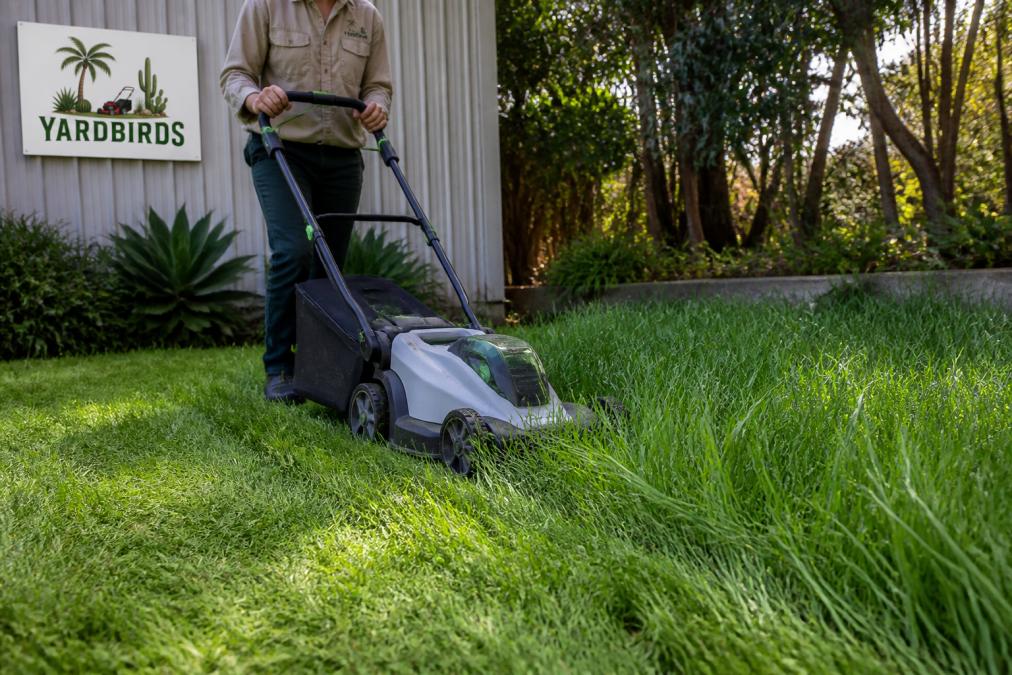
Mowing thick grass requires finesse, not brute force. Most people push hard and stall. The correct technique balances motor load, blade engagement, and battery thermal response.
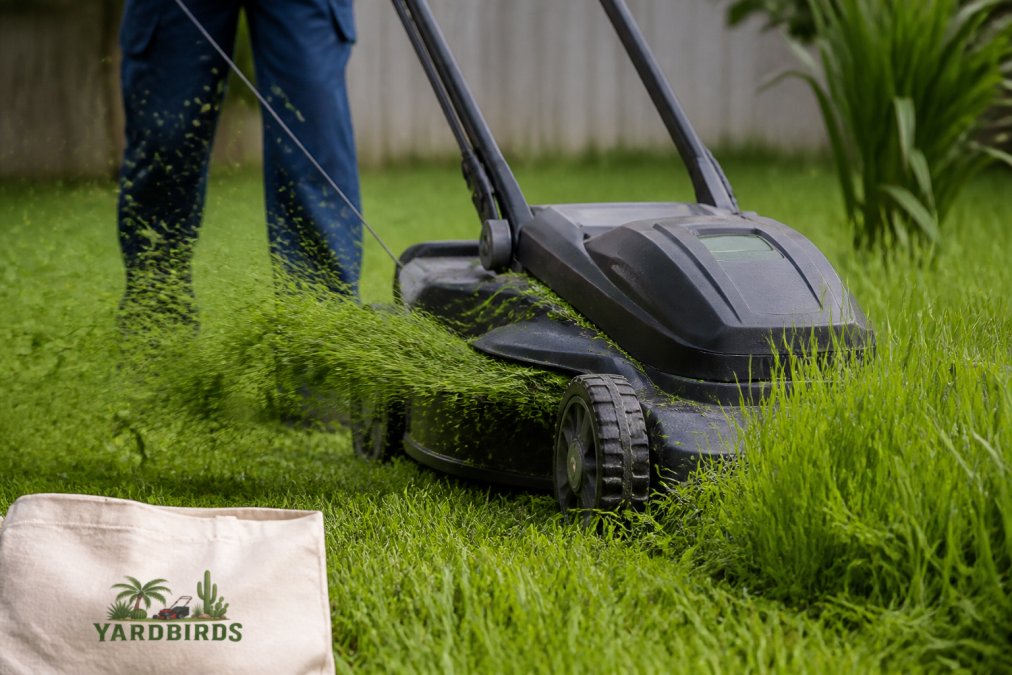
The finesse mowing technique: step-by-step
Step 1: Assess and plan your passes Identify the thickest patches and plan overlapping passes at different heights. Thick grass requires multiple shallow cuts rather than one aggressive pass, with 5-10 cm overlap between passes.
Step 2: Start at maximum safe cutting height Begin at the highest setting (typically 50-60 mm). This reduces grass volume per rotation, keeping motor load manageable and drawing less current from the battery.
Step 3: Maintain steady, unhurried speed Push at a walking pace (approximately 1 metre per second). Do not push harder when you feel resistance; slowing down reduces blade load instantly.
Step 4: Monitor motor sound and feel Listen for pitch changes; rising pitch indicates increasing load. If the motor labours or the mower becomes difficult to push, reduce speed immediately.
Step 5: Complete the first pass, then reassess After 15+ minutes of continuous mowing, allow the battery to cool for 2-3 minutes. Lithium-ion batteries lose voltage as temperature rises; a brief rest restores cutting power.
Step 6: Lower cutting height and repeat Lower the cutting height by 10 mm on your second pass. Grass is now partially cut, so resistance is lower. Maintain the same steady pace.
Step 7: Final pass at target height Complete a third pass at your desired final height (typically 30-40 mm). Most grass is already partially severed, so the motor encounters minimal resistance.
Why this technique works: the physics
Each pass removes a portion of grass mass, distributing the cutting load across three motor cycles instead of one. This keeps motor current draw within the battery's sustainable output range, preventing voltage sag and stalling. A single aggressive pass forces the motor to process all mass simultaneously, causing current demand to spike and the motor to stall.
Grass moisture and thermal management
Damp grass increases cutting resistance by 20-40%. If you must mow damp conditions, add an extra pass, reduce walking speed by 25%, and expect battery run-time to drop by 15-25%.
Lithium-ion batteries operate optimally between 15°C and 35°C. During heavy-load mowing, internal temperature can rise 10-15°C above ambient, reducing current delivery. If your mower feels sluggish after 20 minutes, stop for 5 minutes to cool the battery and restore cutting power.
Overlap strategy for dense patches
In exceptionally thick areas, increase overlap to 15-20 cm. Each blade rotation cuts a narrower swath, reducing instantaneous load and preventing stalling, though mowing takes longer.
Battery Voltage, Torque, and Run-Time for Long Grass
Battery voltage directly affects cutting performance in thick grass. Here's the hierarchy:
40V and above systems
These are the workhorses for thick grass. A 40V brushless motor with a 5-6Ah battery handles overgrown patches without stalling. Run-time in dense growth is 30-40 minutes, enough for most residential properties.
40V systems cost more upfront but deliver reliability when conditions get tough.
36V systems
A solid middle ground. They handle thick grass well if you use proper technique. Run-time is typically 25-35 minutes in dense growth. Suitable for properties up to 500m² with moderate overgrowth.
24V and below
These systems work for thin grass and light maintenance. In thick growth, they struggle. Stalling becomes common. Battery drain accelerates. If your lawn regularly grows thick between cuts, avoid lower-voltage systems.
Amp-hour capacity
A 5Ah battery delivers more sustained power than a 3Ah battery at the same voltage. For thick grass, prioritise amp-hour capacity over voltage alone. A 40V 3Ah system performs worse than a 36V 5Ah system in dense growth.
Best Electric Lawn Mowers for Thick Grass: What Actually Works
The market offers dozens of electric mowers. The ones that handle thick grass share common traits: 36V or higher voltage, brushless motor technology, and cutting decks designed for mulching efficiency. (Source: Safe Work Australia's guidelines on manual handling)
Look for these features:
- Brushless motor: Delivers more torque, runs cooler, lasts longer
- Lithium-ion battery: Superior performance in thick grass compared to nickel-cadmium
- Adjustable cutting height: Allows the multi-pass approach thick grass requires
- Mulching capability: Breaks down clippings, reducing discharge clogging in dense growth
- Deck design: High-lift blades and efficient airflow prevent stalling
For professional or frequent use, 40V systems with 5Ah+ batteries are often recommended. The upfront cost is higher, but reliability in challenging conditions can pay dividends.
Consumer models in the 36V range work well for homeowners with typical properties and reasonable maintenance schedules.
Blade Geometry, Mulching, and Cutting Deck Design
Blade design and deck engineering are the hidden factors separating mowers that handle thick grass from those that fail. Motor power alone does not determine success; blade geometry and airflow dynamics determine how efficiently the motor converts electrical energy into cutting force.
High-lift blade geometry and grass engagement
High-lift blades feature a curved, upswept design that generates vertical airflow as the blade rotates. This airflow lifts grass upright before the cutting edge engages it. In thick, matted, or overgrown grass, this is critical: grass lies flat and tangled, resisting the blade. A standard flat blade must force its way through matted growth, creating high resistance and motor strain.
A high-lift blade's upward airflow separates grass strands, standing them perpendicular to the ground.
Mulching efficiency and motor load reduction
Cutting deck airflow and discharge design
Deck material and blade mounting
- High-lift blade geometry - Non-negotiable for dense growth
- Mulching capability - Reduces clipping volume and discharge clogging
- Side-discharge or rear-discharge design - Avoids bagging bottlenecks
- Steel or reinforced composite deck - Maintains airflow consistency
- Brushless motor with 36V or higher - Provides sufficient torque to drive the blade through thick grass
When to Choose a Gas Mower Over Electric, and When Not To
Electric mowers suit most residential properties. Gas mowers make sense in specific situations.
Choose gas if:
- Your lawn exceeds 1,000m² and grows thick regularly
- You mow less frequently, allowing grass to become overgrown
- You need unlimited run-time without battery swaps
- You're cutting through dense weeds, not just grass
- Your property has thick, wet clay soil that stays damp
Choose electric if:
- You maintain regular mowing schedules (weekly or fortnightly)
- Your property is under 800m²
- You value low noise and zero emissions
- You prefer minimal maintenance and no fuel costs
- Your lawn is typical thickness for your area
Frequently Asked Questions
Can electric mowers really handle thick grass, or is that just marketing?
Electric mowers can handle thick grass, but not in the same way petrol mowers do. They rely on finesse rather than brute force, lighter passes, higher blade speed, and multiple cuts over time work better than trying to power through dense growth in one pass. Lithium-ion batteries with sufficient voltage (typically 36V or higher) and brushless motors deliver consistent torque, but stalling happens if you push too hard. The key is matching the mower's specifications to your lawn density and adjusting your technique.
What's the best electric lawn mower for thick grass?
Look for models with brushless motors, 36V or higher voltage systems, and cutting decks designed for high-lift blades that create strong airflow. Battery amp-hour capacity matters too, aim for at least 4Ah to maintain run-time on dense grass. Adjustable cutting heights and mulching capability help you work through thick growth progressively. Real-world performance varies by lawn density and moisture levels, so test before committing to a full investment.
How long will an electric mower battery last when cutting long grass?
Battery run-time drops significantly on thick, tall grass compared to regular lawn maintenance. A typical lithium-ion battery rated for 45 minutes on normal grass may deliver only 20-30 minutes on dense growth because the motor works harder and draws more current. Voltage sag occurs under sustained load, reducing effective power output. Thermal management matters too, overheating during heavy cutting reduces discharge efficiency. For long grass, plan on multiple battery swaps or plan shorter mowing sessions and return to finish the job.
Why does my electric mower stall in thick grass?
Stalling occurs when blade resistance exceeds motor torque. Wet, damp grass clumps on the cutting deck and increases resistance; tall, dense growth forces the blade to work harder; and dull blades demand extra motor strain. Brushless motors protect themselves by cutting power when current spikes, which feels like stalling. Prevent it by mowing when grass is dry, raising your cutting height on first passes, reducing forward speed, and ensuring blades are sharp. Mulching efficiently reduces deck resistance too.
The challenge with thick grass isn't the equipment, it's matching the right system to your lawn and using the right technique. YardBirds Sydney uses modern electric equipment across Sydney's variable climate because it delivers reliable results when applied properly. Our team understands blade geometry, battery management, and the finesse techniques that keep motors running smoothly through challenging conditions. Get a free quote to see how electric mowing can work for your property.