 ultimate-guide
Strata Garden Maintenance Compliance Checklist
Table of Contents
- Why Strata Garden Maintenance Needs a Compliance Checklist
- Strata Common Property Maintenance Obligations: Know Your Legal Duty
- The Strata Garden Maintenance Schedule Template: A Month-by-Month Plan
- Strata Scheme Work Health and Safety Requirements for Garden Work
- Contractor Management: Insurance, Scope of Works, and Service Agreements
- Environmental Compliance: Chemical Safety and Sustainable Planting
- Auditing and Documenting Your Maintenance Compliance
- Your Compliance Checklist: From Risk Assessment to Remediation
- Frequently Asked Questions
Last Updated: September 6, 2026
Why Strata Garden Maintenance Needs a Compliance Checklist
Strata garden maintenance is more than keeping lawns mowed. For owners corporations, the garden is common property, and the duty to maintain it carries legal weight. A compliance checklist turns an informal routine into a defensible system that protects the scheme, its budget, and its residents.
A compliance checklist is a documented, repeatable process covering scheduled works, contractor oversight, safety obligations, and record keeping. It answers three questions: what must be done, who is responsible, and what evidence proves it was done correctly.
A verbal agreement with a gardener is not compliance. When a tree branch damages a car, a contractor injures themselves, or a resident trips on an uneven path, the scheme needs documentation to show it met its duty of care. Without it, liability can fall back on the owners corporation.
Below, we'll walk through the full compliance picture: your legal obligations, a month-by-month schedule, work health and safety requirements, contractor management, environmental rules, and the audit trail that ties it all together.
Strata Common Property Maintenance Obligations: Know Your Legal Duty
Every strata scheme has a legal obligation to maintain and repair common property, including gardens, lawns, pathways, and shared outdoor areas. This duty is not optional and does not disappear when funds are tight.
The legal foundation varies by state, but the principle is consistent. In New South Wales, section 106 of the Strata Schemes Management Act 2015 requires the owners corporation to maintain and repair common property (legislation.nsw.gov.au). Victoria's Owners Corporations Act 2006 (section 46), Queensland's Body Corporate and Community Management Act 1997 (Schedule 4), and Western Australia's Strata Titles Act 1985 (Schedule 2, by-law 4) carry similar duties. The standard is broadly the same: keep common property in good and serviceable repair.
Maintenance versus improvement: where the line sits
The key distinction in strata law is between maintenance, which is mandatory, and improvements, which require a resolution. The NSW Civil and Administrative Tribunal has consistently held that replacing a worn-out item with a modern equivalent is maintenance, while upgrading to something substantially better is an improvement. For gardens, this means:
- Repairing a cracked concrete path is maintenance.
- Replacing a dying tree with the same species is maintenance.
- Replanting a garden bed with a completely new, higher-specification design is an improvement requiring a special resolution.
- Installing a new automated irrigation system where none existed is an improvement.
- Replacing a broken irrigation controller with a like-for-like unit is maintenance.
If the cost of a repair is significant relative to the scheme's budget, it may be considered 'capital work' rather than routine maintenance, triggering different funding and approval requirements. Committees should check their state's threshold for major capital works.
The practical failure mode: reactive maintenance
The most common compliance failure is a reactive approach, where the scheme acts only when something breaks or causes a complaint. Tribunals have found owners corporations in breach for failing to act on a known defect, even a minor one, because the duty is to maintain, not merely to respond to emergencies.
A documented, preventative maintenance schedule is the evidence the duty has been met. If a resident is injured on an uneven path, the first line of defence is showing the path was inspected regularly and a repair scheduled.
The role of the strata manager
The legal duty sits with the owners corporation, not the strata manager. A manager's failure to arrange a repair does not absolve the corporation of liability. The management agreement should clearly define who schedules garden works, inspects outcomes, and reports to the committee.
The Strata Garden Maintenance Schedule Template: A Month-by-Month Plan
A maintenance schedule is the engine room of your compliance system. It breaks the annual workload into monthly tasks so the committee can verify work against a clear plan.
| Season | Core Tasks | Frequency |
|---|---|---|
| Spring | Lawn feed and weed control, mulch beds, inspect irrigation | Monthly |
| Summer | Weekly mowing, watering management, pest monitoring | Weekly to fortnightly |
| Autumn | Leaf removal, prune shrubs, aerate lawn, service equipment | Fortnightly |
| Winter | Minimal mowing, prune deciduous trees, repair paths and fences | Monthly |
The schedule should name each garden area, the task, the responsible contractor, and the completion date. Turf management might require weekly mowing in summer and every three weeks in winter, while weed eradication peaks after rain.
Winter is not a closed season. While growth slows, it is the correct time for structural pruning, irrigation audits, and path repairs that would damage summer plantings if left until spring.
Strata Scheme Work Health and Safety Requirements for Garden Work
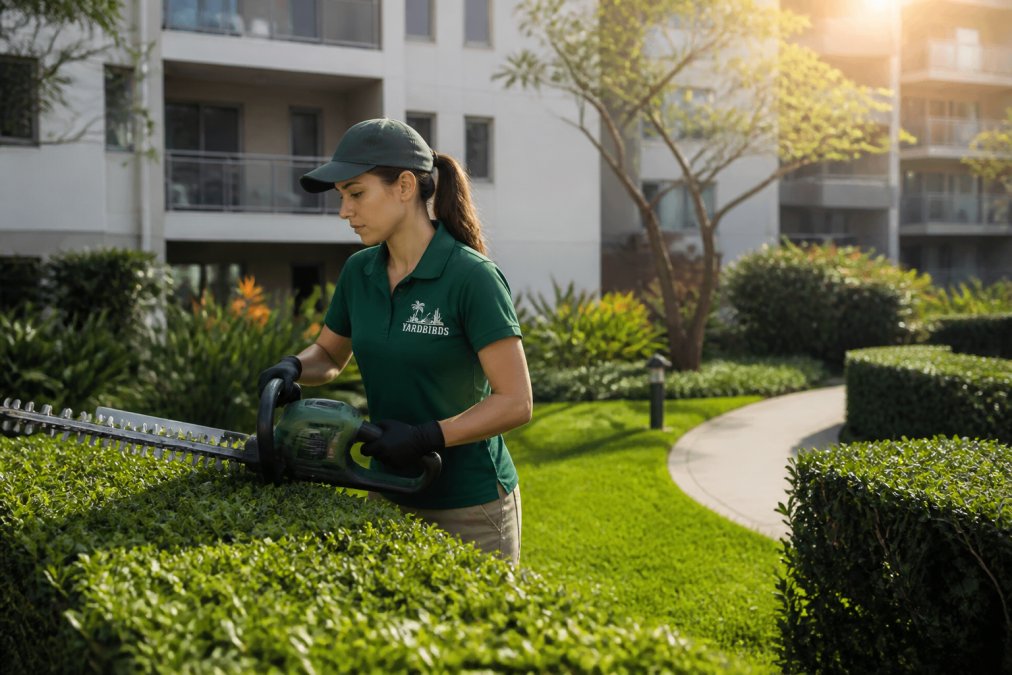
Strata scheme work health and safety requirements apply to anyone carrying out work on common property. The owners corporation, as the person conducting a business or undertaking, has a duty to ensure the health and safety of workers and anyone affected by the work.
A contractor using a ride-on mower on a slope, a worker applying herbicides near gardens, or a tree pruner working at height each carry specific risks. The duty extends to identifying hazards, assessing risks, and implementing controls before work begins.
Practical steps include requiring safe work method statements for high-risk tasks, confirming licences for chemical application or elevated work, and notifying residents before treatments so they can keep children and pets clear.
The scheme should maintain a hazard register recording identified risks, such as uneven paving or overhead power lines near trees, and the controls in place. This becomes critical evidence if an incident occurs.
Contractor Management: Insurance, Scope of Works, and Service Agreements
The quality of your garden maintenance is only as good as the contractor agreement behind it. A strong service agreement protects the scheme and provides the compliance trail a verbal arrangement cannot.
Every contractor should hold current public liability insurance and workers compensation cover. The scheme should request certificates of currency before work starts and at each renewal, and keep copies on file.
The scope of works should describe each task specifically: mow lawns to 40-50 millimetres, edge paths, remove clippings, prune shrubs, and inspect irrigation. Vague instructions like "keep the garden tidy" invite disputes.
A well-drafted service agreement also covers site access, frequency of visits, variation approval, and the process for addressing substandard work. The committee should review contractor performance annually.
Environmental Compliance: Chemical Safety and Sustainable Planting
Chemical use on common property is regulated. Only licensed or suitably trained operators should apply regulated chemicals, and records of application must be kept.
The regulatory framework for chemical application
In Australia, chemicals are regulated federally by the Australian Pesticides and Veterinary Medicines Authority (APVMA), which sets legal conditions of use. Using a chemical inconsistently with its approved label is an offence. A contractor cannot 'just use something stronger' or apply a product to a pest not listed on the label.
Most routine garden chemicals are Schedule 5 or Schedule 6 poisons, requiring a current chemical user certificate or direct supervision by a certified operator (worksafe.qld.gov.au). Some states require a commercial operator's licence for applying chemicals for hire. The committee should sight the contractor's certificate or licence and confirm it is current.
Record-keeping is a legal requirement, not a courtesy
Records of chemical use must be kept for a minimum period, typically two to three years. The record should include:
- The product name and APVMA permit number
- The date and time of application
- The specific area treated
- The target pest or weed
- The rate of application and total amount used
- The name and licence number of the applicator
- Weather conditions at the time of application
This record protects the scheme if a resident claims herbicide drift damaged their plants or a pet becomes ill after walking on a treated lawn.
Water runoff and proximity to communal areas
A specific risk is the proximity of treated areas to drainage systems, vegetable gardens, children's play areas, and water features. Many council approvals restrict chemical use near stormwater drains. Contractors should identify no-spray zones on a site plan and use spot-treatment rather than broad-scale spraying near these areas.
The sustainability angle: native planting and council biodiversity mandates
Beyond chemical safety, a growing compliance layer comes from council environmental regulations. Many councils require native plantings in new landscaping and restrict known environmental weeds. A scheme that ignores these requirements may face fines for allowing an environmental weed to spread.
The committee should check its council's development control plan before significant replanting. Key items to verify include:
- Whether the council requires a development application for landscaping changes in certain zones
- Whether any trees on the property are protected under a Tree Preservation Order or local heritage listing
- Whether the council has a list of declared weeds that must be removed
- Whether the council offers incentives, such as free native plants or rebates, for water-wise garden conversions
Water-wise design as a compliance and cost strategy
Water restrictions during drought are enforced by state and local authorities, and schemes with large exotic lawns are most exposed. Native, drought-tolerant plantings reduce water consumption, lower maintenance costs, and align with council sustainability targets. Many native species also require less fertiliser and fewer chemical interventions.
A practical approach is to phase in native plantings over several years, replacing high-water-use exotic species as they reach the end of their life. This avoids the cost of a full redesign while moving toward sustainability.
Auditing and Documenting Your Maintenance Compliance
Documentation is what separates compliance from chaos. A scheme that maintains its garden perfectly but keeps no records will struggle to prove compliance after an incident. The audit trail is the evidence.
A simple digital system works well: a shared folder with the service agreement, insurance certificates, the maintenance schedule, work logs, chemical application records, and photos. Each visit should generate a brief record confirming what was done, by whom, and any issues for follow-up.
Digital maintenance tracking tools allow the committee to log tasks, assign responsibilities, and store photos in one place. This is valuable for strata managers juggling multiple schemes.
An annual compliance review should check that insurance is current, the schedule has been followed, hazard reports have been actioned, and the budget was spent as planned. This feeds into the next year's budget and schedule.
Your Compliance Checklist: From Risk Assessment to Remediation
Here is the working checklist your scheme can adopt, moving from identifying risk through to fixing problems and recording the outcome.
- Risk assessment: Walk the common property and identify hazards such as unstable trees, uneven paths, or trip hazards in garden beds.
- Budget allocation: Confirm the annual garden maintenance budget covers scheduled works, contingency for storm damage, and contractor compliance.
- Contractor verification: Collect current insurance certificates, licences, and the signed scope of works before any work begins.
- Scheduled maintenance: Run the month-by-month schedule and log each completed task with photos.
- Hazard identification: Record any new issues found during site inspections and assign responsibility for remediation.
- Chemical safety: Verify that any chemical applications are logged, labelled, and carried out by trained operators.
- Site inspection: Conduct a quarterly walkthrough with the contractor to review garden condition and address resident concerns.
- Remediation: Action any defects or hazards promptly and document the fix.
- Annual review: Assess contractor performance, review the schedule for the coming year, and update the compliance file.
This checklist is not a one-off exercise. It should be a living document, reviewed as the garden matures, the contractor changes, or regulations update. Compliance is continuous.
Getting garden maintenance right for a strata scheme takes more than a mower and a good eye. It takes a contractor who understands the compliance landscape, arrives when promised, and documents the work properly. YardBirds Sydney brings that reliability to residential and strata properties across the Inner West, using all-electric equipment for a climate-conscious service. Fully insured and experienced with multi-owner schemes, our team delivers consistent care you can verify. Get a Free Quote and put your common property maintenance on a compliant footing.
Frequently Asked Questions
What are the legal obligations for strata committees regarding common property garden maintenance?
Under the Strata Schemes Management Act 2015, the owners corporation must maintain and repair common property, including gardens and grounds. This duty of care extends to keeping paths and common areas safe to prevent injuries. Committees should arrange regular inspections, approve a maintenance budget, and ensure a service agreement is in place with a qualified contractor.
How often should a strata garden maintenance audit be conducted?
A formal audit of garden maintenance compliance should happen at least once a year, ideally before the high-growth spring season. This audit should review the condition of lawns, trees, and irrigation, check for hazards, and confirm that required documentation like service agreements and risk assessments is current. Seasonal inspections every three months help catch issues early.
What documentation is required to prove garden maintenance compliance?
Keep a compliance file that includes the signed scope of works, the contractor's public liability insurance certificate, and any relevant licences. You should also retain records of site inspection reports, risk assessments, the approved maintenance schedule, and details of any weed eradication or chemical applications. This documentation demonstrates your duty of care if an incident occurs.
How does the Strata Schemes Management Act 2015 affect garden maintenance?
The Act requires the owners corporation to maintain common property in a state of good repair, which includes communal gardens and landscaping. It also provides the power to set maintenance budgets and enter into contracts for services. Committees that neglect these duties may face legal action or be liable for costs associated with injuries or property damage on poorly maintained common areas.
Are strata committees liable for injuries caused by poorly maintained garden paths?
Yes. The owners corporation has a legal duty of care to keep common property safe. If a cracked path, overhanging branch, or slippery surface causes an injury, the owners corporation could be held liable. Regular site inspections and a documented maintenance schedule that includes path repairs and trip-hazard removal are essential for managing this risk.