 how-to
How to Manage Sydney Summer Weeds: A 2026 Guide
Table of Contents
- Why Summer Weeds Take Over Sydney Lawns
- Identifying Common Lawn Weeds in Summer
- What You'll Need Before You Start
- Step 1: Scout and Map Your Weed Problem
- Step 2: Choose Your Control Method
- Step 3: Best Practices for Lawn Mowing Height
- Step 4: Preventing Weed Growth in Summer
- Common Mistakes to Avoid
- Frequently Asked Questions
Last Updated: September 12, 2026
Why Summer Weeds Take Over Sydney Lawns
By December, most Inner West lawns have already lost the battle. Heat, humidity and afternoon storms combine to push summer weeds into overdrive, and a lawn that looked sharp in October can be patchy and seeded by January. At YardBirds Sydney, we see the same pattern every season: couch and buffalo lawns thin out under heat stress, bare patches open up, and within a fortnight something else has moved in.
The reason is simple. Weeds are opportunists, not aggressors. They colonise bare ground, compacted soil and turf that is already struggling. Manage the lawn's health and density, and you remove the invitation. That is the throughline of this guide, and it runs through every step below.
Identifying Common Lawn Weeds in Summer
Identifying common lawn weeds starts with two questions: is it a grassy weed or a broadleaf, and is it a perennial that regrows from roots or an annual that spreads by seed? The answer decides your control method more than anything else.
Summer's usual suspects in this area:
- Summer grass (crabgrass family): Annual grassy weed, seeds heavily in heat, dies back in autumn but leaves a seed bank behind.
- Paspalum: Perennial grassy weed, clumping habit, thrives in damp, warm patches and mown-too-low edges.
- Bindii: Broadleaf, prickles by late summer, spreads fast across thin turf.
- Capeweed and chickweed: Broadleaf annuals that germinate in bare or compacted ground.
- Dandelion and catsear: Perennials with taproots, so pulling the top off does nothing.
Native lookalikes trip people up. Some native groundcovers and grasses resemble weeds at seedling stage, so if you are unsure whether a plant is native or invasive, check with a local nursery or council before spraying. Getting this wrong is one of the most common mistakes we see.
What You'll Need Before You Start
Before you do anything, gather the right kit. Trying to manage weeds with the wrong tools wastes time and damages the lawn you are trying to protect. But in this climate, the kit list is not just about tools, it is about accounting for the coastal humidity, sudden storms, and the specific grass varieties that dominate local lawns.
- Gloves, eye protection and a mask if using any chemical product
- A weeding fork or hand trowel for taprooted weeds
- A sharp mower with an adjustable deck height
- A knapsack or pressure sprayer, clearly labelled
- Selective and, if needed, non-selective herbicide suited to your grass type
- Wetting agent and a quality lawn fertiliser
- A soil pH test kit
- Mulch for garden beds bordering the lawn
- A pet-safe or organic herbicide option if you have dogs, cats or backyard wildlife
Check the label on any herbicide before you buy it, and confirm it is registered for use on your specific grass variety. Couch, buffalo, kikuyu and zoysia all respond differently, and some products will set your lawn back badly if you get it wrong. If you are unsure, ask at a local nursery or consult your council's weed officer, many councils offer free identification and advice.
Pet and wildlife safety: Many common broadleaf herbicides contain active ingredients that are toxic to dogs and cats if ingested, and can persist on lawns for days after application. If your pets use the lawn, look for products labelled as pet-safe once dry, or consider non-chemical methods first. Native birds and lizards can also be affected by residual chemicals, so always follow withholding periods strictly.
Local microclimates: The region's coastal humidity and summer storm patterns mean that weed germination can be staggered, some patches dry out while others stay damp. A moisture meter (available from most hardware stores) can help you decide when to water and when to hold off, preventing the overwatering that encourages weeds like paspalum.
Step 1: Scout and Map Your Weed Problem
Scout your lawn in the morning, when the light is low and the moisture is still on the leaf. Walk the whole area, not just the front patch you see every day. Note where weeds are clustered, which species are present, and whether the turf underneath is thin, compacted or shaded.
Sketch a rough map. Mark the dense patches, the bare spots and any drainage lines. This matters because weed density tells you whether you are dealing with a seeding problem, a soil problem, or both. If you find the same weed returning in the same spot every year, the seed bank in that soil is the issue, not the plant you keep pulling out.
Scouting takes ten minutes. Skipping it usually costs you a season.
Step 2: Choose Your Control Method
Choose your control method based on the weed species, your grass type and how much of the lawn is affected. For small, isolated patches, manual removal is fastest and safest. For widespread infestations, you are looking at an integrated approach: mechanical control, mowing discipline, soil improvement and targeted herbicide use together.
Natural Weed Control Methods That Work
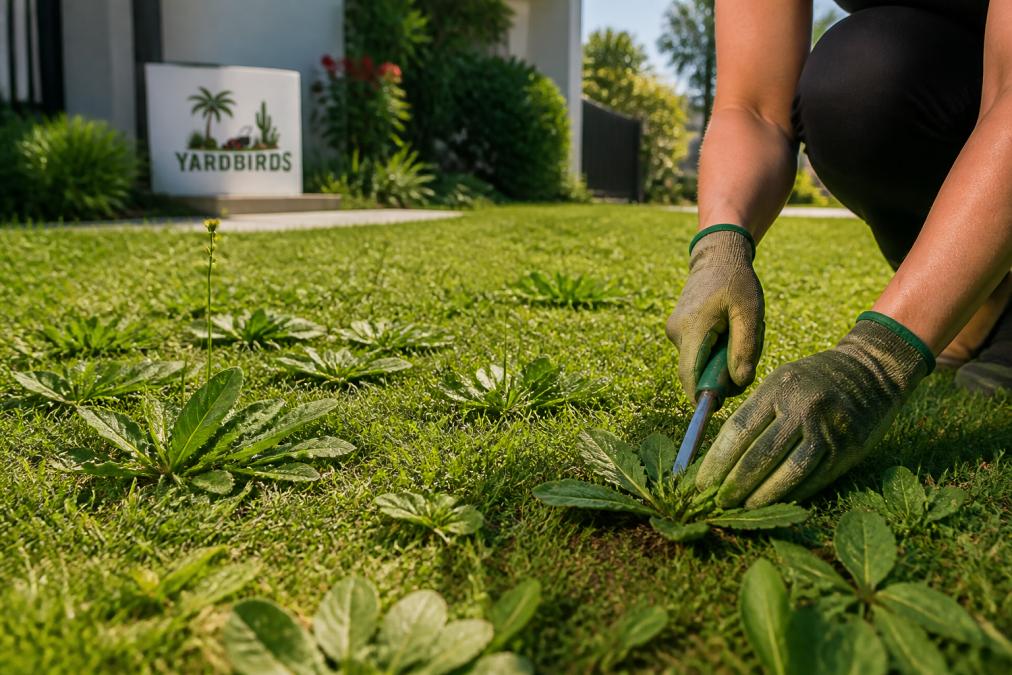
Natural weed control methods are most effective when used early and consistently. Hand removal works well for taprooted broadleaf weeds if you get the whole root, and it is the safest option around pets and wildlife. Mulching garden beds to a decent depth suppresses seedling germination by blocking light at the soil surface. Improving soil health with compost and a wetting agent thickens the turf, which is the single best long-term weed suppression you can buy. For larger areas, a dense, well-fed lawn outcompetes most annual grasses without any chemical input at all.
Herbicides: Pre-Emergent vs Post-Emergent
Pre-emergent herbicides create a residual barrier at the soil surface that stops weed seeds germinating. They must be applied before germination, which in this climate means late winter to early spring for summer weeds. Once the weed is up and actively growing, a pre-emergent does nothing.
Post-emergent herbicides are knockdown products applied to the leaf of an existing weed. Selective types target broadleaf weeds without harming your grass; non-selective types kill anything they touch and are best reserved for paths, edges and garden beds.
| Product Type | When to Apply | Best For | Limitation |
|---|---|---|---|
| Pre-emergent | Before germination | Annual grasses, bindii | No effect on established weeds |
| Selective post-emergent | Active growth | Broadleaf in turf | Grass-type dependent |
| Non-selective post-emergent | Any time, spot only | Paths, beds, edges | Kills turf on contact |
| Manual removal | Any time | Isolated taprooted weeds | Labour intensive |
Step 3: Best Practices for Lawn Mowing Height
Best practices for lawn mowing height come down to one rule: never remove more than a third of the leaf blade in a single cut. Scalping the lawn opens bare ground, stresses the turf and hands weeds a free germination site.
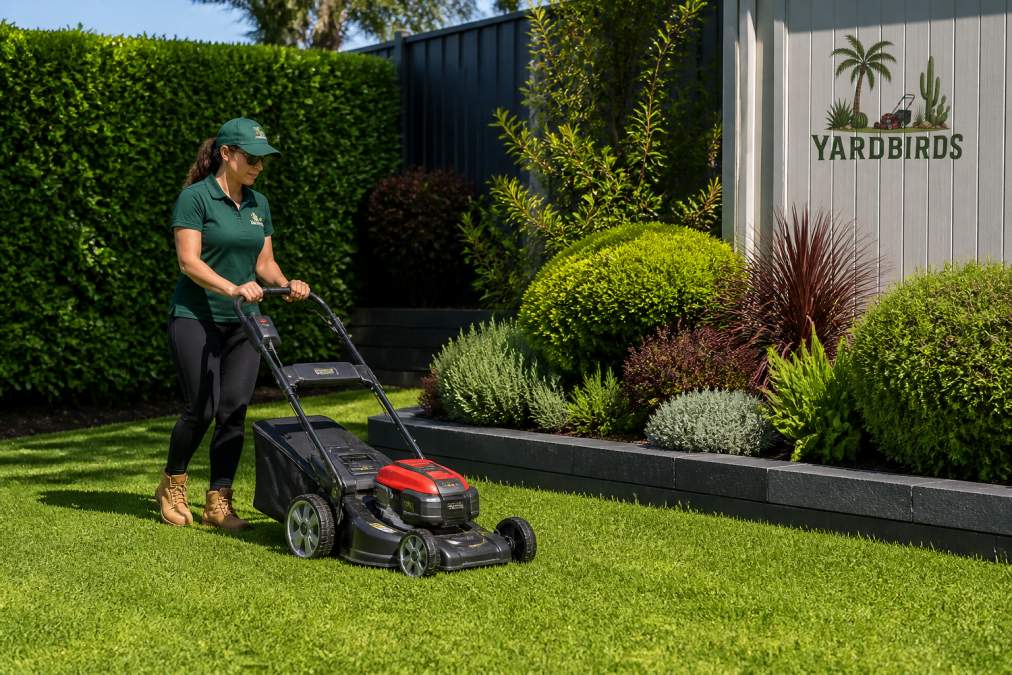
Raise your deck for summer. Warm-season grasses generally cope better at a taller height during heat stress, because more leaf shade means cooler soil and less moisture loss. Keep blades sharp, mow in the cooler part of the day, and vary your mowing direction each time to avoid ruts and scalped strips. If the lawn has gone too long between cuts, take it down in stages over two or three mows rather than all at once.
Step 4: Preventing Weed Growth in Summer
Preventing weed growth in summer is about moisture, density and timing, but in this region, it is also about understanding the unique pressures of coastal humidity, storm patterns, and the mix of native and invasive species that thrive here. A one-size-fits-all approach will leave you chasing the same patches year after year.
Moisture management: Water deeply and less often to encourage deep roots. In sandy soils, which are common in many older suburbs, water can drain quickly, so a wetting agent applied in early summer helps maintain even moisture. However, overwatering is just as bad, it creates the damp conditions that favour weeds like paspalum. Use a moisture meter or simply push a screwdriver into the soil: if it goes in easily, hold off watering.
Density and soil health: Feed the lawn during active growth so it thickens and closes gaps. Top-dress bare patches with seed or turf suited to your grass type. But before you sow, check whether the bare patch is caused by compaction, shade, or grubs, if you do not fix the underlying issue, weeds will return. Aerating compacted soil in early summer can dramatically improve turf density (dpi.nsw.gov.au).
Mulching and edging: Keep garden beds mulched to at least 7-10 cm deep and edged so runners do not creep in. But be careful: some native groundcovers look like weeds at seedling stage. If you are unsure whether a plant is native or invasive, check with a local nursery or council before pulling it out. Many native groundcovers are valuable for local wildlife and should be kept.
Native vs. invasive identification: This is a gap most guides miss. Common native lookalikes include:
- Native violet (Viola hederacea): A groundcover with purple flowers that can be mistaken for broadleaf weeds. It is beneficial and should not be sprayed.
- Kidney weed (Dichondra repens): A native groundcover often confused with chickweed. It is non-invasive and tolerates shade.
- Weeping grass (Microlaena stipoides): A native grass that can look like summer grass but is desirable in some lawns.
If you are unsure, take a photo and use a plant identification app, or ask at a local nursery. Never spray a plant you cannot identify.
Monitoring and scouting: Stay on top of scouting, catching a seedling is a five-minute job, while catching a seeding weed is a season-long one. Walk your lawn weekly, especially after storms, and remove weeds before they set seed.
Cost-benefit: DIY vs professional
| Factor | DIY | Professional |
|---|---|---|
| Time commitment | 2-4 hours per week in peak summer | Minimal, scheduled visits |
| Equipment cost | $200-$500 upfront for sprayer, herbicides, tools | Included in service fee |
| Chemical handling | You manage safety and disposal | Licensed applicators manage risks |
| Expertise | Learning curve; risk of misapplication | Trained in local weed species and turf types |
| Long-term results | Variable; depends on consistency | Often more consistent due to integrated approach |
For small lawns with minor weed issues, DIY is cost-effective. For larger properties, severe infestations, or if you are time-poor, a professional service can be more economical when you factor in trial-and-error costs and potential lawn damage. Many local providers offer free assessments, so it is worth getting a quote before you commit to a season of DIY.
Common Mistakes to Avoid
The biggest mistake is treating weeds as the problem rather than the symptom. Spraying a broadleaf weed out of a thin lawn just clears space for the next one.
Other repeat offenders:
- Mowing too low in summer, which stresses turf and exposes soil
- Applying pre-emergent after weeds have already germinated
- Pulling taprooted weeds by the top and leaving the root to regrow
- Using non-selective herbicide near lawn edges and losing turf to overspray
- Ignoring compaction, which keeps soil tight and turf shallow
- Leaving bare patches unseeded through the growing season
Weed resistance is worth knowing about too. Repeated use of the same herbicide group on the same species can select for resistant plants over time, so rotate active ingredients and lean on mechanical and cultural control where you can (grdc.com.au).
If the job is bigger than a weekend, or you would rather not handle herbicides yourself, that is a reasonable call. YardBirds Sydney offers fully insured, all-electric lawn and garden maintenance across the Inner West, with a 97% satisfaction rate across 500+ customers and over 12 years of experience. Our team handles weed suppression, mowing height and soil health as one job, so you are not chasing the same patches every month.
Frequently Asked Questions
What is the most effective way to kill weeds in the summer?
The most effective approach combines early intervention with the right method. For small patches, hand-pulling after rain when soil is soft works well. For larger infestations, a post-emergent herbicide sprayed on actively growing weeds during cooler parts of the day is effective. Improving turf health through proper mowing height and watering also helps the lawn outcompete summer weeds naturally.
Is it better to pull weeds out or spray them?
It depends on the weed type and scale. Hand-pulling works for annual weeds with shallow roots, especially after rain. However, weeds with taproots or rhizomes often regrow if any root remains. Spraying with a selective herbicide is more practical for broadleaf weeds spread across a large lawn. For best results, identify the weed first, then choose the method that targets its root system.
When is the best time to avoid spraying weeds during summer?
Avoid spraying when temperatures are forecast to exceed 30°C, during strong winds, or when rain is expected within six hours. Early morning or late afternoon is ideal because weeds are actively growing and spray drift is minimised. Never spray on heat-stressed turf, as the herbicide can damage the lawn along with the weeds.
How do I prevent weed growth in summer without chemicals?
Maintain a dense, healthy lawn by mowing at the correct height for your grass type, watering deeply but infrequently, and applying mulch to garden beds. Hand-pull weeds before they set seed. Improving soil health with organic matter helps turf thicken and crowd out weeds naturally. These natural weed control methods reduce the need for chemical application over time.
Summer weeds will always test a lawn, and the seasons where heat and humidity line up are the hardest. The work that pays off is unglamorous: scouting early, mowing at the right height, feeding the soil and staying ahead of germination. If you want that handled properly, get a free quote from YardBirds Sydney and keep your lawn thick, healthy and weed-resistant through the worst of the season.